 Fulfilled
One Column Page
and responsive to boot
A Case for the Death of the Two Witnesses During the Purim Festival of AD 68
by
Adam Maarschalk
This article appeared in the 2026 Fall issue of Fulfilled! Magazine
Numerous suggestions have been made for the identity of the two witnesses in Revelation 11. Proposals include Moses and Elijah, Enoch and Elijah, Peter and Paul, the old covenant and the new covenant, and the law and the prophets. Based on the context given in Revelation 11:1-13, it was necessary for the two witnesses to have a connection with the high priesthood, to prophesy for 3.5 years, to have protection from enemies who wanted to harm them, to have power over the sky and the waters, to be killed by the beast in Jerusalem, to not be allowed burial, to be celebrated in death for 3.5 days, and to be caught up to heaven in a cloud; additionally, these events would take place at the time of a great earthquake that killed 7,000 people (10 percent of Jerusalem’s population).
In this verse-by-verse study (all Scripture quotes from the NASB), I will propose that the two witnesses were two former high priests who were killed at the time of the Festival of Purim in early AD 68, coinciding with the Zealot Temple Siege. Their deaths occurred within 24 hours of an earthquake that killed thousands in Jerusalem, they were not allowed to be buried, and their enemies rejoiced over their demise. Before looking at these details, however, let’s consider why two witnesses were needed in the first place. According to the law of Moses, a matter of sin or wrongdoing could only be confirmed if there were two or three witnesses:
“A single witness shall not rise up against a person regarding any wrongdoing or any sin that he commits; on the testimony of two or three witnesses a matter shall be confirmed” (Deut 19:15).
Likewise, the condemned could only be put to death if there was testimony from two or three witnesses:
“On the testimony of two witnesses or three witnesses, the condemned shall be put to death; he shall not be put to death on the testimony of only one witness” (Deut 17:6).
With this in mind, two witnesses prophesying against “the great city” in Revelation 11 (later also called “the harlot”) further confirms that this city/harlot was under the jurisdiction of the law of Moses. This is not true of 21st-century New York City, Vatican City, Las Vegas, or any other modern city. It was first-century Jerusalem that came under judgment, after first being condemned by two witnesses in accordance with Mosaic law.
The two witnesses are first introduced in Revelation 11:3. We will begin, though, by looking at verses 1-2, which provide the setting and other background information for the activity of the two witnesses.
Revelation 11:1
“Then there was given to me a measuring rod like a staff; and someone said, ‘Get up and measure the temple of God and the altar, and those who worship in it’” (Rev 11:1).
John was told to measure a temple which clearly still existed. This was the famous “Herod’s temple” in Jerusalem. The downfall of this temple is one of the most clearly marked out events in all of ancient history, taking place in AD 70. Yet, John was told to measure it prior to its downfall.
If John wrote the book of Revelation in AD 95 or AD 96, as the popular idea goes, the temple would have fallen about 25 years earlier. Yet John didn’t mention the downfall of the temple as a past event, nor did he question why the angel asked him to measure a monumentally significant temple that had just recently been destroyed. Instead, John was told to measure a temple that was still present, had an altar, and hosted worshipers. This, of course, is compelling evidence that the book of Revelation was written before Jerusalem’s destruction in AD 70.
Revelation 11:2
“‘Leave out the courtyard which is outside the temple and do not measure it, because it has been given to the nations; and they will trample the holy city for forty-two months’” (Rev 11:2).
John was told that the nations would capture the temple’s outer court and that the holy city was going to be trampled for 42 months (3.5 years). This is a clear echo of what Jesus had predicted almost 40 years earlier. In Luke’s version of the Olivet Discourse, Jesus declared that the temple would be torn down with no stone left upon another (Luke 21:1-6). He added that there would be “great distress upon the land” of Judea and wrath toward the people of Jerusalem (Luke 21:20-23). One feature of this distress would involve Jerusalem being trampled underfoot by the Gentiles (Luke 21:24).
“. . . for there will be great distress upon the land, and wrath to this people; and they will fall by the edge of the sword, and will be led captive into all the nations; and Jerusalem will be trampled underfoot by the Gentiles until the times of the Gentiles are fulfilled’” (Luke 21:23-24).
Here in Revelation 11, John was told how long that trampling would last – 42 months. I would submit that the 42 months of trampling the city took place from the fall of AD 66 until the spring of AD 70. A careful look at The Wars of the Jews by Josephus reveals that this was the period of time when the Romans were absent from Jerusalem and the Jewish Zealots had control of the city. In early AD 68, Jesus ben Gamala, a former high priest, gave a speech in which he described how the Zealots were trampling the city like wild beasts:
“And this place, which is adored by the habitable world, and honored by such as only know it by report, as far as the ends of the earth, is trampled upon by these wild beasts born among ourselves” (Wars 4.4.3).1
In what sense were the Zealots Gentiles? First, the primary meaning of “Gentiles” is “nations.” Two of the three main Zealot leaders (Eleazar ben Simon, John Levi, and Simon Bar Giora) who orchestrated so much bloodshed in Jerusalem were not from Judea, but from other nations.
Simon was from Gerasa (Wars 4.9.3), which at the time was one of the cities of the Roman Decapolis and today is in Jordan. By the time that Simon “got possession of Jerusalem” in April AD 69 (Wars 4.9.12), he had an army of more than 40,000 people, including Idumeans, who he had gathered from the countryside.
John was from Gischala (Galilee). In early AD 68, he invited the Idumeans (Edomites) to come up to Jerusalem. They came as an army of 20,000, led by four generals, and slaughtered thousands of people within the gates of Jerusalem (Wars 4.5). Josephus referred to their actions as “foreign assistance” to the Zealot cause (Wars 4.4).
There’s a second sense in which even the Jews could be described as “the Gentiles.” Among the given meanings for the Greek word “ethnos,” translated as “Gentiles” (Strong’s Greek: 1484)2, are the words “heathens” and “pagans.” In the book of Revelation, John no doubt describes a great deal of pagan and heathen activity in Jerusalem. Anyone who reads the descriptions of the Zealots given by Josephus will quickly see that their behavior was lawless, pagan, and heathen. Collectively, said Josephus, they made Jerusalem and the temple into their own “shop of tyranny” (Wars 4.3.7).
Revelation 11:3
“And I will grant authority to my two witnesses, and they will prophesy for 1,260 days, clothed in sackcloth” (Rev 11:3).
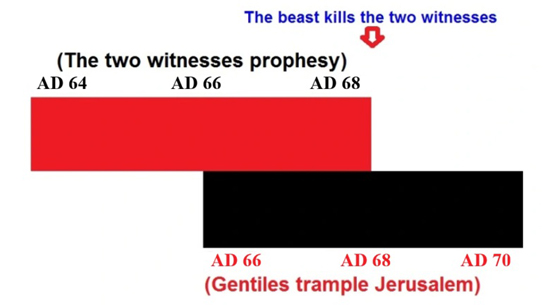
Here, we see the designation of another time period equal to 3.5 years. Instead of 42 months (verse 2), this time period is said to last 1,260 days. These time periods were identical in length, but did they begin and end at the same time? I don’t believe they did, and this may be the reason for the two different ways of labeling these time periods. After the two witnesses were eliminated, the city continued to be trampled before ultimately being judged. Therefore, the 1,260 days of the two witnesses began before the nations began to trample the city for 42 months. My proposal of these overlapping timelines is as follows:
The two witnesses were to be clothed in sackcloth while they prophesied. Sackcloth, according to Bible Gateway’s Dictionary of Bible Themes, was “a coarse, black cloth made from goat’s hair that was worn together with the burnt ashes of wood as a sign of mourning for personal and national disaster, as a sign of repentance and at times of prayer for deliverance.”3 The first instance of sackcloth in the Bible was when Jacob wore sackcloth and mourned, after being falsely convinced that his son Joseph was dead (Gen 37:34). Other instances included the people and animals of Nineveh wearing sackcloth while repenting of sin (Jonah 3:5-9) and Daniel wearing sackcloth while praying and pleading with God to forgive and restore Judah, Jerusalem, and all Israel (Dan 9:3). Wearing sackcloth was an ancient practice, but it is not a modern one, which further confirms that the two witnesses belonged to the first century rather than to this present era.
Revelation 11:4
“These are the two olive trees and the two lampstands that stand before the Lord of the earth” (Rev 11:4).
This description of the two witnesses as olive trees and lampstands directly parallels Zechariah’s “Vision of the Lampstand and Olive Trees”:
“Then the angel who had been speaking with me returned and woke me, like a person who is awakened from his sleep. And he said to me, ‘What do you see?’ And I said, ‘I see, and behold, a lampstand all of gold with its bowl on the top of it, and its seven lamps on it with seven spouts belonging to each of the lamps which are on the top of it; also two olive trees by it, one on the right side of the bowl and the other on its left side.’ … Then I said to him, ‘What are these two olive trees…?’ …Then he said, ‘These are the two anointed ones, who are standing by the Lord of the whole earth’” (Zech 4:1-3, 11, 14).
This vision came on the heels of Zechariah’s “Vision of the High Priest,” concerning the high priest, Joshua (Zech 3), who served alongside the governor, Zerubbabel (Zech 4). In Zechariah’s vision, he saw one lampstand (Zech 4:2), representing the high priest, Joshua. In Revelation 1:12, John saw seven lampstands, which he was told were the seven churches (Rev 1:20). Here in Revelation 11:4, there were two lampstands, the two witnesses. This representation suggests a connection between the office of the high priest and the two witnesses.
Zechariah 4 compares very nicely with Revelation 11. The context of Zechariah 4 was the building of the temple in Jerusalem after the Assyrian and Babylonian exile. The context here in Revelation 11 is the impending destruction of that same temple.
| Olive Trees, Lampstands, Standing by the Lord | |
| Zechariah 4 | Revelation 11 |
| “a lampstand all of gold” | “the two lampstands” |
| “these two olive trees” | “the two olive trees” |
| “the two anointed ones” | “My two witnesses” |
| “that stand before the Lord of the earth” | “who are standing by the Lord of the whole earth” |
Ananus ben Ananus and Jesus ben Gamala
I would like to propose that the two witnesses were two first-century high priests, Ananus ben Ananus and Jesus ben Gamala (also known as Joshua). According to Josephus, they led the peace movement in Jerusalem when the Zealots were determined to rebel and incite war with the Romans, hoping to gain full independence for Israel. As we will see, their roles, their deaths, the circumstances and aftermath of their deaths, and the timing of their deaths line up with a number of details that John saw in Revelation 11. Here is a short summary of these two men.
1. Ananus ben Ananus: The appointment of Ananus as high priest is recorded in Antiquities 20.9.1. He was appointed in AD 62, but only served for about three months. Josephus called him “the ancientest of the high priests” and “a very prudent man” (Wars 4.3.7), “a prodigious lover of liberty” who “preferred peace above all things,” and “a shrewd man in speaking and persuading the people” (Wars 4.5.2). A long speech given by Ananus against the Zealots is recorded in Wars 4.3.10.
2. Jesus ben Gamala: The appointment of Jesus as high priest is recorded in Antiquities 20.9.4. He was appointed around AD 63, but only for about a year (Antiquities 20.9.7). Josephus referred to Jesus as “a friend and companion” (Life 41.204)4, and called him “the eldest of the high priests next to Ananus.” Josephus added that “although he was inferior to [Ananus] upon the comparison, he was superior to the rest” (Wars 4.5.2). Jesus also gave a long speech against the Zealots, which is recorded in Wars 4.4.3.
Revelation 11:5
“And if anyone wants to harm them, fire flows out of their mouth and devours their enemies; and so if anyone wants to harm them, he must be killed in this way” (Rev 11:5).
Compare the language in this verse to what Jeremiah and Hosea were told about the impact of their prophetic words:
“Behold, I am making My words fire in your mouth, and this people wood, and it will consume them” (Jer 5:14).
“‘Is My word not like fire?’ declares the Lord, ‘and like a hammer which shatters a rock?’” (Jer 23:29).
“Therefore I have cut them in pieces by the prophets; I have slain them by the words of My mouth; and the judgments on you are like the light that shines” (Hos 6:5).
Revelation 11:6
“These have the power to shut up the sky, so that rain will not fall during the days of their prophesying; and they have power over the waters to turn them into blood, and to strike the earth with every plague, as often as they desire” (Rev 11:6).
By way of comparison, during the days of Elijah, “it did not rain for three years and six months” (James 5:17; Luke 4:25). Interestingly, this matches the duration of time that the two witnesses would prophesy (Rev 11:3). During the Roman siege in AD 70, Josephus gave a speech to the Zealots in which he pointed out that the springs of water were “almost dried up” while Jerusalem was in the hands of the Zealots but suddenly had more than enough water once the Romans arrived:
“…and as for Titus, those springs that were formerly almost dried up when they were under your power since he is come, run more plentifully than they did before; accordingly, you know that Siloam, as well as all the other springs that were without the city, did so far fail, that water was sold by distinct measures; whereas they now have such a great quantity of water for your enemies, as is sufficient not only for drink both for themselves and their cattle, but for watering their gardens also” (Wars 5.9.4.409-410).
Josephus said that Ananus had “the mastery of those that opposed his designs, or were for the war” (Wars 4.5.2). Josephus didn’t give many details about how he mastered his opponents, but this indicates that Ananus remained untouchable for a period of time. At the same time, as Josephus explains in great detail, the Zealots were having their way in Jerusalem and eliminating others who threatened their agenda.
Revelation 11:7
“When they have finished their testimony, the beast that comes up out of the abyss will make war with them, and overcome them and kill them” (Rev 11:7).
Although the two witnesses had the upper hand and God’s protection during the giving of their testimony, once it was finished, they were allowed to be killed. Ananus and Jesus were both killed simultaneously during what was called the Zealot Temple Siege of February-March AD 68, roughly 1.5 years after the Jewish-Roman War began.
The Zealot Temple Siege
This siege took place after the Zealots appointed a fake high priest, Phannias, who “did not well know what the high priesthood was” (Wars 4.3.6-8), and he unworthily presided over that post until Jerusalem was destroyed. Phannias was a fraud, and the people of Jerusalem finally had enough of the Zealots. Ananus and Jesus led them in an uprising:
“And now the people could no longer bear the insolence of this procedure, but did altogether run zealously, in order to overthrow that tyranny… The best esteemed also of the high priests, Jesus the son of Gamala, and Ananus the son of Ananus, when they were at their assemblies, bitterly reproached the people for their sloth, and excited them against the zealots…” (Wars 4.3.9).
In his speech (Wars 4.3.10), Ananus said that he would lead the people in an all-or-nothing attack against the Zealots, and that he would not spare his own body in that effort. In that battle, Ananus and his followers actually gained the upper hand against the Zealots, forcing them into the inner temple and gaining control of the rest of the city (Wars 4.3.12). Ananus then chose 6000 armed men to keep the Zealots surrounded and under guard. Unfortunately, this strategy came undone because of the trickery of John Levi of Gischala (Wars 4.3.13-14).
John Levi of Gischala was a Zealot leader who had recently come to Jerusalem, but he pretended to be on the side of Ananus and was invited to be an ambassador to the Zealots (Wars 4.3.13). John quickly betrayed Ananus and falsely claimed that he had invited the Roman general Vespasian to conquer Jerusalem (Wars 4.3.14).
In response, the Zealot leaders Eleazar ben Simon and Zacharias ben Phalek requested help from the Idumeans, who lived south of Judea. The Zealots told the Idumeans that “unless they would come immediately to their assistance… the city would be in the power of the Romans.” Even though the Zealots were trapped in the inner temple, they somehow managed to sneak out two messengers to deliver a letter to the Idumeans (Wars 4.4.2-3). In fulfillment of Revelation 9:13-16, the Idumeans quickly prepared an army of 20,000 directed by four commanders (Wars 4.4.2):
“Now these [Idumean] rulers were greatly surprised at the contents of the letter, and at what those that came with it further told them; whereupon they ran about the nation like madmen, and made proclamation that the people should come to war; so a multitude was suddenly got together… and twenty thousand of them were put into battle-array, and came to Jerusalem, under four commanders...”
When the Idumeans came to Jerusalem, Jesus invited the Idumeans to help deliver the city from the real enemies, the Zealots, but the Idumeans were not persuaded (Wars 4.4.3-4). In the midst of a terrible storm and an earthquake that night, the Zealots managed to come out of the temple and use saws to cut through the gates. This allowed the Idumeans to enter the city, and the Zealots joined them in slaughtering the guards (Wars 4.5.1). The next day, the Idumeans, working on behalf of the Zealots, hunted down and killed Ananus and Jesus, who had long tormented the Zealots by opposing their war and working for peace:
“[The Idumeans] sought for the high priests, and…went with the greatest zeal against them; and as soon as they caught them they slew them, and then standing upon their dead bodies, in way of jest, upbraided Ananus with his kindness to the people, and Jesus with his speech made to them from the wall…” (Wars 4.5.2).
Revelation 11:8
“And their dead bodies will lie on the street of the great city which spiritually is called Sodom and Egypt, where also their Lord was crucified” (Rev 11:8).
Here is the first mention in the book of Revelation of “the great city” (later mentioned in Rev 14:8; 16:19; 17:18; 18:10, 16, 18-19, 21). “The great city” is clearly defined as Jerusalem, the place where Jesus was crucified (e.g., Luke 9:31).
It’s significant that the beast oversees the deaths of the two witnesses in Jerusalem (verse 7). The Romans were not in Jerusalem from the fall of AD 66 until April AD 70. If the events of Revelation 11 took place any time between late AD 66 and the spring of AD 70, the beast that overcame the two witnesses was Jewish, not Roman. The deaths of Ananus ben Ananus and Jesus ben Gamala took place in February-March AD 68, in the middle of the time period during which the Romans had no access to Jerusalem.
Revelation 11:9
“Those from the peoples, tribes, languages, and nations will look at their dead bodies for three and a half days, and will not allow their dead bodies to be laid in a tomb” (Rev 11:9).
This is how Josephus described the actions of the Idumeans and the Zealots after they succeeded in killing Ananus ben Ananus and Jesus ben Gamala:
“Nay, they proceeded to that degree of impiety, as to cast away their dead bodies without burial… I should not mistake if I said that the death of Ananus was the beginning of the destruction of the city… He…preferred peace above all things; …he was a shrewd man in speaking and persuading the people, and had already gotten the mastery of those that opposed his designs, or were for the war… And this at last was the end of Ananus and Jesus” (Wars 4.5.2).
So, John and Josephus both described two individuals in Jerusalem who were hated, virtually invincible for a period of time, finally killed, and not allowed to be buried.
Revelation 11:10
“And those who live on the earth will rejoice over them and celebrate; and they will send gifts to one another, because these two prophets tormented those who live on the earth” (Rev 11:10).
The expression translated here as “the earth” is translated in the literal translations as “the land,” i.e., the land of Israel. This is a regular pattern in the book of Revelation (and beyond)5, but an understanding of this expression as referring to the land of Israel is certainly fitting here, as the two witnesses were killed in Jerusalem.
In verse 9, we read that “peoples, tribes, tongues, and nations” would see the dead bodies of the two witnesses. Why was there such a diverse population in Jerusalem at that time? This was often the case when a festival or feast day, like Passover, took place in the city, and Jews from various nations gathered there.
The details given in verses 9 and 10, when put together, reflect the festival of Purim, the Jewish holiday that recalls and celebrates the deliverance of the Jewish people from Haman who plotted to kill them. This celebration became a time of feasting, rejoicing, sending gifts to one another, etc. (Esther 9:22). This festival is still celebrated in this way.6
The deaths of Ananus and Jesus are commonly said to have taken place in February or March AD 68. The Fast of Esther and Purim are typically celebrated from the 13th – 16th of Adar. In the year AD 68, the last day of Adar was March 22nd, according to our modern calendar.7 Therefore, since each Jewish month was 29 or 30 days, we can know that the Fast of Esther and Purim took place around March 4-7 in AD 68.
It seems possible that when the Zealots and their followers celebrated Purim in March AD 68, they not only recognized the deliverance from Haman that took place in Esther’s day, but they also celebrated being free from Ananus and Jesus and all of their efforts toward peace with Rome. After all, the people believed the lie told by John of Gischala — that Ananus had invited Vespasian to capture Jerusalem and to deliver them to the Romans.
A short while later, another Zealot leader, Simon Bar Giora, found out that Ananus was dead. He was at Masada, about 80 miles from Jerusalem (Wars 2.22.1-2). When Simon “heard of the death of Ananus, he…went into the mountainous part of the country. So he proclaimed liberty to those in slavery, and a reward to those already free, and got together a set of wicked men from all quarters” (Wars 4.9.3). Like the Zealots in Jerusalem, Simon rejoiced and promised gifts to others because of the elimination of Ananus and Jesus.
Revelation 11:11-12
“And after the three and a half days the breath of life from God came into them, and they stood on their feet, and great fear fell upon those who were watching them. And they heard a loud voice from heaven saying to them, ‘Come up here.’ And they went up into heaven in the cloud, and their enemies watched them” (Rev 11:11-12).
Here (and also in verse 9), John is told that the celebration over the deaths of the two witnesses would last for “three and a half days.” Typically, Purim is celebrated for two days. However, from time to time, there is a Triple Purim (Purim Meshulash). If the 15th of Adar happens to fall on the Sabbath, “the days of Purim are spread over the course of three days, as opposed to two.”8 This was perhaps also the case in March AD 68.
For the remainder of the text in verses 11-12, I admittedly do not have an explanation at this time that I feel is adequate. I’m not aware of any parallels in the writings of Josephus (or elsewhere) that seem to depict two individuals (or entities) rising up to heaven in a cloud while their enemies observed them. That is, I’m not able to point to any obvious parallel in history to most of the language expressed in Revelation 11:11-12. Is the picture of rising “up into heaven in the cloud” symbolic of vindication, an enduring legacy, heaven’s validation of their message, or something else? Did Ananus and Jesus embrace the gospel and become followers of Christ (something that we shouldn’t expect, in any case, for Josephus to mention)? Hopefully, they did. Ananus, after all, is the one who earlier had ordered the execution of James, the brother of Jesus, in AD 62 (Antiquities 20.9.1). Whether or not our readers agree that Ananus ben Ananus and Jesus ben Gamala were the two witnesses, your thoughts and insights on these two verses (and anything else) are most welcome.
Revelation 11:13
“And at that time there was a great earthquake, and a tenth of the city fell; seven thousand people were killed in the earthquake, and the rest were terrified and gave glory to the God of heaven” (Rev 11:13).
In Wars 4.4.5, Josephus described an earthquake that took place the night the Idumeans broke into Jerusalem, shortly before Ananus and Jesus were killed:
“[F]or there broke out a prodigious storm in the night, with the utmost violence, and very strong winds, with the largest showers of rain, with continued lightnings, terrible thunderings, and amazing concussions and bellowings of the earth, that was in an earthquake… anyone would guess that these wonders foreshowed some grand calamities that were coming.”
That same night, in the midst of the storm, the Idumeans slaughtered those who had tried to prevent them from coming in:
“The zealots also joined in the shouts raised by the Idumeans; and the storm itself rendered the cry more terrible; nor did the Idumeans spare anybody; for as they are naturally a most barbarous and bloody nation, and had been distressed by the tempest, they made use of their weapons against those that had shut the gates against them… Now there was at present neither any place for flight, nor any hope of preservation; but as they were driven one upon another in heaps, so were they slain… And now the outer temple was all of it overflowed with blood; and that day, as it came on, they saw eight thousand five hundred dead bodies there” (Wars 4.5.1).
What John was told concerning 7,000 deaths is very close to the 8,500 deaths recorded by Josephus. It’s possible that 7,000 died in the earthquake and that another 1,500 died at the hands of the Idumeans. Furthermore, this earthquake and the deaths of Ananus and Jesus were less than 24 hours apart, making them eligible to be the two witnesses who died “at that time.”
Typically, estimates of Jerusalem’s population in the first century range from 30,0009 to 100,00010 people, so it’s very reasonable to conclude that 7,000 deaths in AD 68 represented a tenth of the city falling. Even if the normal population was closer to 30,000, it would have been higher at the time of that earthquake if it took place around the Festival of Purim. This was a minor festival, so the population may have doubled, but it wouldn’t have swollen to 250,000 or more as it did during the major festivals.
Jerusalem Took a Turn for the Worse
The deaths of Ananus and Jesus marked a significant turning point for Jerusalem, according to Josephus:
“I should not mistake if I said that the death of Ananus was the beginning of the destruction of the city, and that from this very day may be dated the overthrow of her wall, and the ruin of her affairs, whereon they saw their high priest, and the procurer of their preservation, slain in the midst of their city… to say all in a word, if Ananus had survived they had certainly compounded matters… And the Jews had then put abundance of delays in the way of the Romans, if they had had such a general as he was” (Wars 4.5.2).
After their deaths, the Zealots and the Idumeans “fell upon the people as upon a flock of profane animals, and cut their throats.” Others endured “terrible torments” before finally meeting their deaths. At least 12,000 died in that massacre (Wars 4.5.3).
Then one of the Zealots told the Idumeans that they had been tricked and that Ananus and the high priests never did plot to betray Jerusalem to the Romans. So, the Idumeans regretted their actions, saw “the horrid barbarity of [the Zealots who] had invited them,” and left Jerusalem (Wars 4.5.5). The Zealots, no longer hindered by the high priests or even the Idumeans, then increased their wickedness:
“[T]he zealots grew more insolent, not as deserted by their confederates, but as freed from such men as might hinder their designs, and put some stop to their wickedness. Accordingly they made no longer any delay, nor took any deliberation in their enormous practices, but made use of the shortest methods for all their executions, and what they had once resolved upon, they put in practice sooner than anyone could imagine…” (Wars 4.6.1).
In summary, Ananus and Jesus were two former high priests and the most prominent of the high priests during the Jewish-Roman War. As such, they fit the Old Testament imagery of olive trees and lampstands representing those who stood before the Lord in the service of the temple. Until the time of their deaths, they were immune to the harm that their enemies wanted to inflict upon them. They gave speeches predicting the destruction that would come to Jerusalem because of the Zealots and due to the rejection of their message of peace. Jerusalem experienced a drought during that time. They were killed by the Idumeans under the order of the Zealots, their enemies. They were not allowed to be buried, and their enemies rejoiced over their deaths. This happened at the same time as an earthquake and the deaths of 8,500 people, some from the earthquake itself and some by the sword. These events, their role as high priests, and their prophetic warning against the city of Jerusalem line up very well with the details given in Revelation 11:3-13 concerning the two witnesses who would precede the culmination of judgment against that city.
1. This and other citations from The Works of Josephus can be found online: Flavius Josephus - Complete Works and Writings. (n.d.). Bible Study Tools. https://www.biblestudytools.com/history/flavius-josephus/
2. Strong’s Greek: 1484. ἔθνος (ethnos) — Nation, Gentile, people. (n.d.). Bible Hub. https://biblehub.com/greek/1484.htm
3. Manser, M. (Ed.). (2009). 6742 sackcloth and ashes - Dictionary of Bible Themes. Bible Gateway. https://www.biblegateway.com/resources/dictionary-of-bible-themes/6742-sackcloth-ashes
4. Josephus, Life 41.204, http://www.sacred-texts.com/jud/josephus/autobiog.htm
5. A 3-part study on this pattern can be seen here:
[1] https://adammaarschalk.com/2010/02/19/the-earth-as-a-common-reference-to-israel-in-revelation-part-1/
[2] https://adammaarschalk.com/2010/02/19/the-earth-as-a-common-reference-to-israel-in-revelation-part-2/
[3] https://adammaarschalk.com/2010/02/20/the-earth-as-a-common-reference-to-israel-in-revelation-part-3/
6. Chabad.org. (2000, February 23). How to Celebrate Purim - Your Purim 2025 guide contains the story of Purim, and all you need to know about the 4 mitzvahs of Purim and the other observances of the day. Chabad.Org. https://www.chabad.org/holidays/purim/article_cdo/aid/1362/jewish/How-to-Celebrate-Purim.htm
7. Taylor, I. (Ed.). (1851). The Jewish war: a new tr., by R. Traill, ed. with notes by I. Taylor. Houlston & Stoneman, p. 191. https://books.google.com/books?id=9OcCAAAAQAAJ
8. Mostov, A. (2025, March 11). Moishe Moment - Last Triple Purim for 20 Years. Mem Global. https://memglobal.org/news/moishe-moment-last-triple-purim-for-20-years/
9. Ross, A. (2006). Daily Life in The Time of Jesus. Bible.Org. https://bible.org/article/daily-life-time-jesus
10. Chancey, M. A. (2017, June 20). Jerusalem in the New Testament Period. Bible Odyssey. https://www.bibleodyssey.org/articles/jerusalem-in-the-new-testament-period/
Comments:
Your honest review will help others in their search for truth. If you must leave a negative review please be gracious.
Rather, speaking the truth in love, we are to grow up in every way into him who the head, into Christ . . . .
(Ephesians 4:15)
We use "Disqus" commenting software. If you are not familiar with "Disqus," click here for more information. You don't need a Disqus account to post comments, however, without an account you won't be notified if someone responds to your post.